
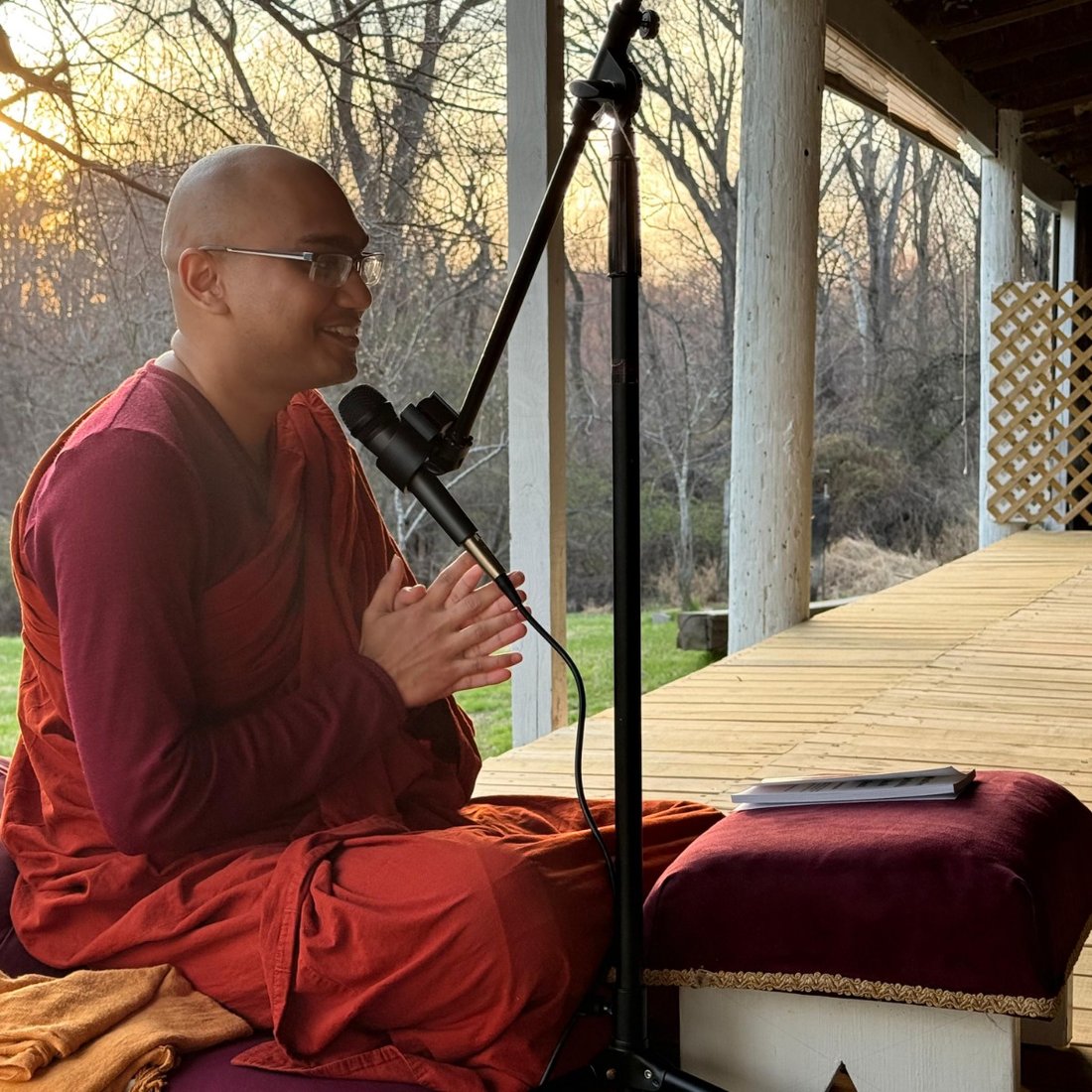
A Guided Meditation Session by a Buddhist Monk
The session combined guided meditation instruction with a live Q&A on common challenges, including intrusive thoughts, a wandering mind, discontentment, difficult retreat experiences, and sleepiness during meditation. Bhante emphasized returning attention to present experience, gently redirecting the mind without harsh self-judgment, and cultivating loving-kindness. The session concluded with a guided mettā meditation.
Meditation Guidance
Intrusive thoughts: Bhante explained that deliberately repeating “nothing” is still a form of thinking and mental effort. Rather than trying to force the mind into blankness, practitioners were encouraged to return attention to a present-moment meditation object, such as the breath, while allowing thoughts to arise and pass naturally.
This is broadly consistent with the Buddha’s instructions on mindfulness of breathing:
“Just mindful, they breathe in. Mindful, they breathe out.”
The emphasis is not on forcing thoughts to disappear, but on establishing mindfulness and repeatedly knowing present experience.
Wandering mind
Bhante described the wandering mind partly through a modern psychological framework, explaining that the mind naturally scans for possible problems or dangers. Rather than treating distraction as a meditation failure, practitioners were encouraged to notice that attention has wandered and gently return to the meditation object.
The early Buddhist texts approach distracting thoughts somewhat differently. In MN 20, the Buddha gives several methods for dealing with unskillful thoughts, beginning with intentionally directing attention toward a more skillful object.
Falling asleep
For practitioners struggling with sleepiness, Bhante recommended experimenting with very short sitting periods—such as one minute—opening the eyes between periods and alternating sitting with two or three minutes of walking meditation.
The precise one-minute method is Bhante’s practical recommendation rather than a technique explicitly prescribed in the early texts. However, walking meditation as a response to drowsiness has a clear canonical precedent. In AN 7.61, the Buddha gives Mahāmoggallāna several progressively stronger methods for overcoming sleepiness, including walking meditation.
“Set a distance to meditate walking back and forth … It’s possible that by doing this you will shake off your drowsiness."
Q&A Highlights
Anxiety and discontent after a year without travel
Stacy
Stacy asked whether feeling anxious and dissatisfied after being unable to travel indicated a failure to develop inner peace.
Bhante encouraged observing thoughts rather than immediately identifying with them and investigating what underlying discomfort or desire might be sustaining the mental loop. Present-moment awareness can help reveal the conditions giving rise to discontent rather than relying entirely on changes in external circumstances for relief.
This can be understood through the Buddha’s instructions to contemplate the mind and mental phenomena, including their arising and passing away.
Self-hatred and rigid judgment during a meditation retreat
A participant described experiencing self-hatred and harsh judgment during an intensive retreat.
Bhante explained that highly structured retreat environments may work well for some practitioners but not for everyone. Excessive rigidity can discourage a person from continuing meditation. He recommended approaching the mind with patient, gentle guidance rather than attempting to control it through fear or harshness.
The analogy of treating the mind like a child should be understood as Bhante’s teaching metaphor rather than a direct quotation or standard analogy from the early Buddhist texts.
Bhante also recommended researching a retreat before attending—speaking with previous participants, examining the daily timetable, and considering whether its intensity and structure are appropriate for one’s circumstances.
Join a Meditation Program Guided by Experienced Buddhist Monks
The Guided Meditation Session on Loving kindness

The session concluded with guided loving-kindness (mettā) meditation.
Participants began by remembering a beloved person or animal and allowing the associated feeling of warmth and goodwill to become clear. They were then encouraged to release the particular memory while retaining the quality of loving-kindness itself. That goodwill was progressively expanded toward oneself, family members, and ultimately all beings.
This particular sequence reflects the method Bhante used during the session rather than a fixed sequence prescribed by the Buddha. The underlying cultivation of unrestricted goodwill, however, is firmly grounded in the early teachings.
AN 8.1 describes the value of developing a mind of loving-kindness:
“If, with a mind free from hate, one arouses love toward just one being, one thereby becomes good. Compassionate in mind toward all beings, the noble one generates abundant merit.”
Upcoming Programs
- Wednesday: Sutta class on the Buddha’s teachings, 8:00–9:00 PM.
- Thursday: Weekly online meditation session.
- Sunday: In-person evening meditation sessions in the Washington, DC area.
- First and third Saturdays: Day-long retreats.
- August 29: FitDC Yoga Fest, with a meditation session led by Bhante.
- September 19 or 20: Meditate with the Monk at the Washington Monument, weather permitting, featuring Bhante Pima and Bhante Panacara.
- Future retreat: Plans are being developed for a five-to-seven-day retreat. Fundraising efforts are intended to allow the retreat to be offered without a participation fee and supported through voluntary donations.
Overall Takeaway
The central practical message of the session was not to wage war against the mind. When thoughts arise, attention wanders, dissatisfaction appears, or sleepiness develops, the practitioner can first recognize what is happening and then respond skillfully.
The early teachings likewise emphasize knowing the state of the mind and cultivating conditions that lead away from greed, aversion, delusion, and heedlessness. Meditation is therefore not measured simply by whether thoughts disappear. More important is whether practice develops mindfulness, steadiness, wholesome qualities, and clearer understanding of how suffering arises and ceases.
Visit the Learn Page to explore more Dhamma content.


